|
Transition radiation detectors are suitable for direct measurements of the
energy spectra of individual elements in cosmic rays up to energies of
1015 eV.
They combine the advantages of good energy resolution and a large
detection area with a relative small weight.
Transition radiation detectors have been used successfully in the
cosmic ray nuclei detector (flown on the Spaceshuttle in 1985) and
the TRACER experiment.
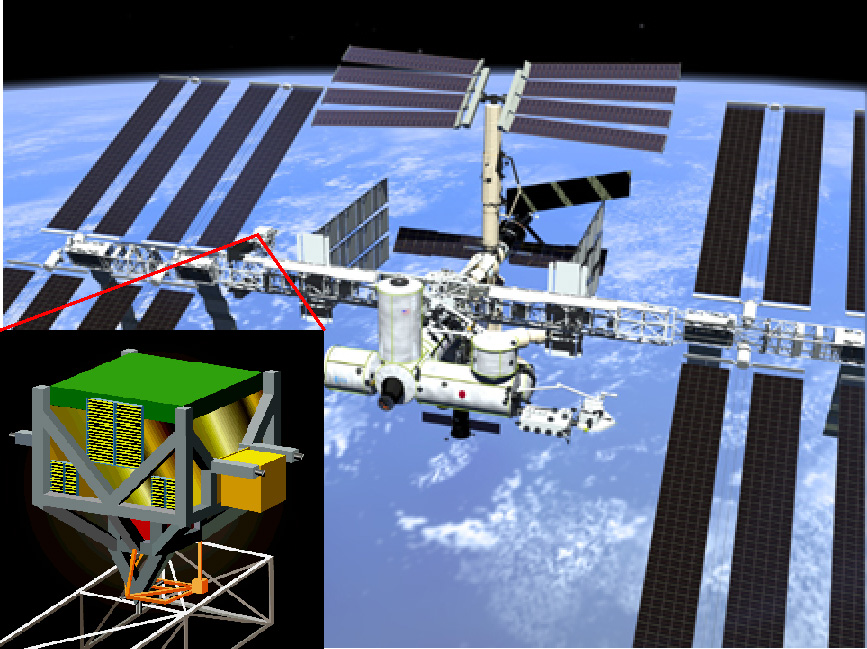
A transition radiation detector is part of the planned experiment ACCESS
(Advanced Cosmic-ray Composition Experiment for the Space Station)
on the International Space Station ISS.
|
|
|
|
Prototypes for a transition radiation detector have been tested at CERN in August 2001. The studies
have been conducted by the University of Chicago and the University of
Karlsruhe.
|
|
|
|
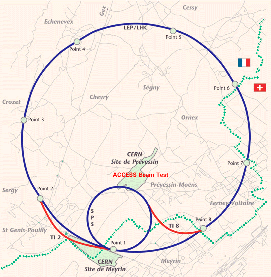
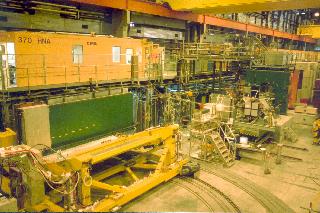
The test set-up has been positioned in a secondary beam of the SPS in the
North Area (H2 beam line).
|
|
|
|
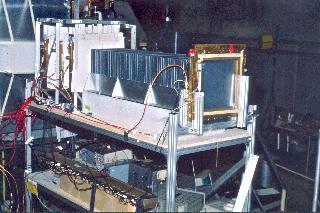
The set-up consists of four multiwire proportional chambers, filled
with a xenon methane mixture.
The first chamber measures the specific ionization.
The chambers two to four are arranged behind the radiator materials
and detect the sum of the energy deposit due to specific ionization
and transition radiation.
On the bottom, the preamplifier electronics is visible, it has
been used previously on the cosmic ray nuclei detector of the
University of Chicago.
|
|
|
|
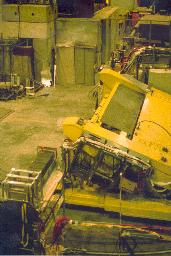
Set-up of the teststand in the beamline.
Top right, the beam pipe with multiwire proportional chambers to
monitor the beam position and the trigger counters.
Bottom left, the transition radiation test set-up.
|
|
|
|
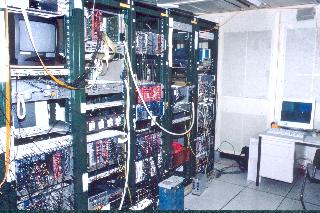
View of the control room of the H2 beam line.
The rack with the data acquisition system and the data taking computer
for the transition radiation detector are on the right.
|
|
|
|
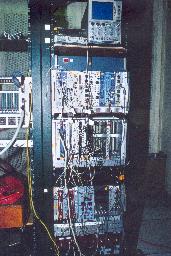
The data acquisition system, including trigger electronics and
high voltage supplies for the multi wire proportional chambers and the
photomultipliers is located in several VME and NIM crates.
The read-out is controlled by a WIENER
PCI VME Interface.
The multi wire proportional chambers are read out via a
SIS 3300 ADC system,
which has been adapted by Struck for this application.
The signals of the photomultiplier tubes are digitized by
Le Croy 1182 ADCs.
|
|
|